
Saint Martin of Tours, Bishop (316 – 397)
The Life and Legacy of Saint Martin of Tours
Saint Martin is among the saints whose veneration and memory have spread most widely throughout the Church. In Europe, several thousand churches and monasteries are dedicated to him; numerous cities, castles, islands, and other locations bear his name, and various folk traditions (such as the blessing of new wine or the arrival of the first snow) are associated with his feast day.
Despite living in the distant 4th century, we know a great deal about his life. This is primarily thanks to his disciple, Sulpicius Severus, who wrote a comprehensive biography of the saint. Sulpicius's accounts can be critically cross-referenced with the writings of Saint Paulinus of Nola and other contemporaries who left valuable written testimonies.
Saint Martin of Tours was the son of a senior Roman military officer, born in 316 or 317 in the Roman garrison town of Sabaria in Pannonia (modern-day Szombathely, Hungary). While he was still a child, his father was transferred to Pavia in northern Italy, where Martin received a solid basic education. He did not pursue higher studies because his father forced him to join the army at the age of fifteen—two years earlier than was customary.
The Cloak and the Conversion
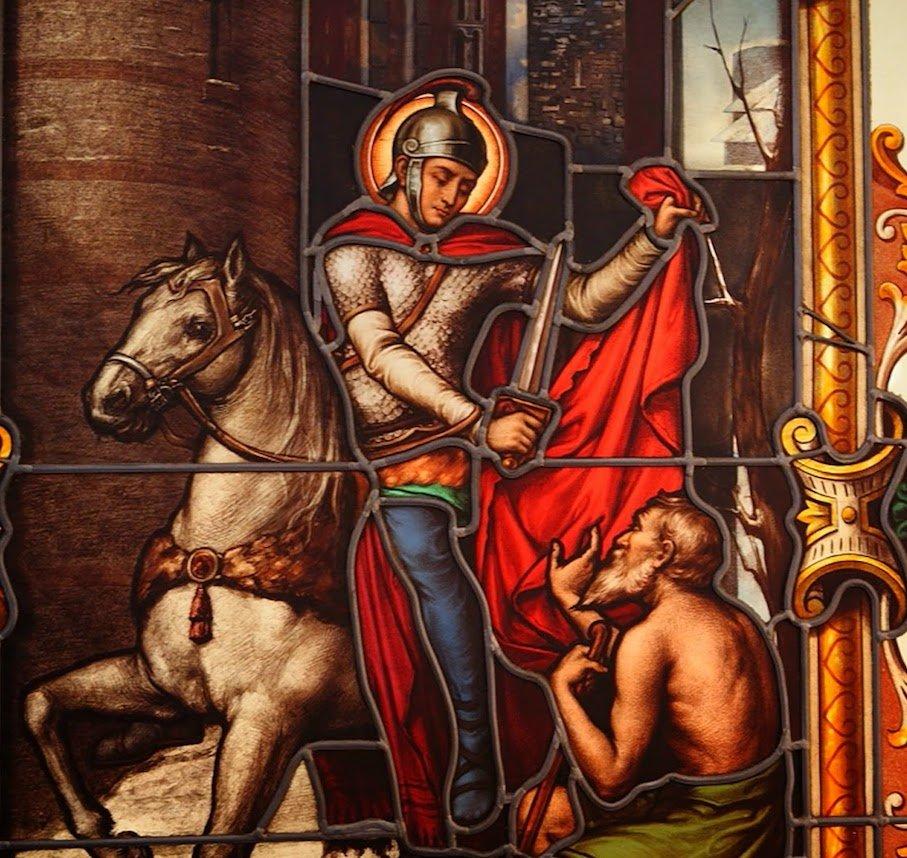
In Pavia, Martin encountered Christianity and enrolled as a catechumen. His parents were pagans, and his father, in particular, adhered to the ancient traditions associated with the imperial cult. As a young soldier, Martin was transferred to the city of Amiens in northern Gaul (present-day France). It was there that the most famous episode of his life occurred—a scene famously depicted by countless artists and perfectly characteristic of this saint.
One freezing winter night, while patrolling the city streets to inspect the military guards, Martin spotted a half-naked beggar pleading for alms. Having no money on him but wanting to protect the poor man from the bitter cold, he drew his sword, cut his military cloak in half, and gave one piece to the beggar. The following night, Christ appeared to him in a dream, wrapped in the half-cloak he had given away. At the time, Martin was still a catechumen. He was baptized at Easter in 339, at the age of 22 or 23.
Leaving the Sword for the Cross
After his baptism, Martin desired to dedicate himself to the service of God, but as a member of the imperial guard, leaving the military was not easy. He remained in the army for about fifteen more years, reaching the rank of officer. He was highly regarded for his camaraderie and cheerful nature, always remaining within the bounds of Christian virtue. Although he had a servant, as was customary for officers, he treated him as a brother: they ate at the same table, and when the servant was exhausted, Martin would wait on him.
In March 354, Martin participated in a military campaign against the Germanic Alemanni. Before the battle, soldiers were to receive a special bounty known as a donativum. Martin refused this bonus and informed his commander that he wished to leave the army. Furious, the commander accused his subordinate of cowardice. To prove that fear was not his motive, Martin offered to advance against the enemy ahead of the entire army, armed with nothing but a cross. As it happened, the battle never took place; an Alemanni envoy appeared and sued for peace. Christians viewed this as a miracle, and Martin was subsequently discharged from the army without further difficulty.
The former officer traveled to Poitiers in western Gaul, seeking out Bishop Hilary (Saint Hilary of Poitiers), of whom he had likely heard. The zealous bishop received Martin warmly and wished to ordain him a deacon. Martin, however, declined. Aside from his deep humility, this decision may have been influenced by the fact that clergy and faithful were often reluctant to see former soldiers in spiritual ministry (later Church regulations explicitly forbade conferring major orders on former military personnel). Hilary therefore instituted Martin as an exorcist, a minor order in the Church, allowing him to be more deeply immersed in ecclesiastical service and theological study.
The Hermit and the Wonderworker
One night, Martin had a profound dream in which he received a divine instruction to convert his elderly parents in Pannonia. He took leave of Bishop Hilary with a promise to return. Following an adventurous journey, he found his parents, though he only succeeded in winning his mother for Christ. He remained in Pannonia for a time, where he frequently clashed with the followers of the Arian heresy. Because they were protected by Emperor Constantius himself, the Arians dared to insult and even publicly punish Martin for his defense of the Catholic faith.
Persecuted for his beliefs, the confessor fled to Milan, only to learn that Bishop Hilary of Poitiers had been exiled to distant Phrygia. Martin stayed in Milan, living as a hermit on the outskirts of the city, until the Arian Bishop Auxentius drove him out. He then retreated to Liguria, living as a hermit with a priest friend on the island of Gallinaria.
In early 360, Martin received word that Bishop Hilary was returning from exile. He rushed to Rome to meet him but missed him, eventually reuniting with him in Poitiers. The bishop joyfully welcomed Martin back and ordained him a deacon, and later, most likely, a priest. However, Martin did not remain in the city. With Hilary's blessing, he lived outside the walls as a hermit while simultaneously preaching the Gospel to the rural population. Soon, several companions joined him, leading to the foundation of the Abbey of Ligugé—the oldest known monastery in Western Europe. It was during this time that miracles began to accompany Martin's ministry, and his reputation as a wonderworker spread rapidly.
Bishop of Tours and the Marmoutier Abbey
When Bishop Liborius of Tours (north of Poitiers) died in 371, the local clergy and faithful wanted Martin as their new shepherd. Knowing he would resist, they lured him to the city under the pretense of visiting a gravely ill woman. As Martin approached Tours, the faithful ambushed him and led him triumphantly into the city, where he was overwhelmingly elected bishop. Yielding to their will, he was consecrated as Bishop of Tours, likely on July 4, 371.
A unique hallmark of Martin’s episcopacy was his relentless missionary work among the vast rural populations. At the time, pastoral care was heavily concentrated in the cities, leaving the rural people—especially agricultural serfs—spiritually abandoned. Having witnessed their plight during his ten years at Ligugé, Martin was determined to help them.
Beyond undertaking extensive missionary journeys himself, he established a center for the formation of the clergy in Marmoutier, near Tours, where clerics were specifically trained for rural ministry. The clergy at Marmoutier lived a quasi-monastic life. They held all property in common, prayed together, and ate together. Their diet and clothing were remarkably simple and poor. The young clerics dedicated much of their time to copying the Holy Scriptures and the works of early Christian writers. This not only preserved and spread invaluable Christian literature but also equipped the young priests with the necessary knowledge for successful ministry.
A Pioneer of Pastoral Care
According to Sulpicius Severus, his disciple and first biographer, Marmoutier became a school of asceticism, but also a nursery for monks and future bishops. From Tours, and through Marmoutier, Martin spearheaded an apostolic movement that transformed much of Gaul.
He introduced several innovations that profoundly shaped the future of the Church. One such milestone was the establishment of rural parishes. This naturally led to another innovation: the pastoral visitation. Every year, Martin visited all the parishes of his sprawling diocese. He traveled by donkey, by boat, or simply on foot. While staying in the parishes, he would sleep in the church sacristy, always accompanied by a few monks and clerics.
Wherever possible, Martin founded small rural monasteries during his travels. These became the vibrant epicenters of Christian life in the countryside. This model of small ascetic communities widely expanded and was instrumental in the Christianization of rural Gaul in the 4th and 5th centuries.
A Defender of the Weak
Biographers recount numerous miracles through which God glorified His servant. Martin, however, never sought to draw attention through extraordinary deeds. His miracles were profound acts of faith, or even more so, expressions of burning charity aimed at helping those afflicted by misfortune or injustice. He healed the possessed, lepers, and the sick, and even raised the dead.
People particularly admired his fearless courage. He routinely stood face-to-face with dangerous enemies who found themselves powerless to harm him. On several occasions, he boldly confronted harsh rulers, securing the release of the unjustly imprisoned or those condemned to death. Driven by justice and Christian humanity, he even went directly to Emperors Valentinian and Maximus.
His deep sense of justice and Christian charity went so far that he defended the Spanish ascetic Priscillian, whom the Synod of Bordeaux had condemned as a heretic in 384. At the insistence of the Spanish Bishop Ithacius, the emperor had Priscillian executed and issued draconian decrees against his followers. Martin deeply regretted that ecclesiastical matters had been brought before a secular state court and considered Bishop Ithacius's actions profoundly un-Christian. He traveled to Emperor Maximus in Trier twice to save those condemned to death. The emperor finally yielded, on the condition that Martin would restore ecclesial communion with Ithacius. Although Martin considered Ithacius's conduct reprehensible, he complied with the emperor's demand, thereby preventing a massive slaughter in Spain.
Death and Veneration
Bishop Martin of Tours lived to be over 80 years old. He died on November 8, 397, during a pastoral visit to the rural parish of Candes. His body was transported along the Loire River to Tours, where he was buried on November 11 amid a massive gathering of the faithful. Two thousand monks and consecrated virgins marched at the head of the funeral procession. He was buried in a suburban cemetery in a simple grave among the common faithful, exactly as he had wished. Soon, however, a basilica dedicated to him was erected over his tomb.
Saint Martin of Tours is among the first Confessors—that is, non-martyrs—to whom the Church granted the title of saint and liturgical veneration. His cult spread phenomenally. In France alone, over 3,600 churches and monasteries were dedicated to him. He was also deeply venerated in Italy, Germany, Austria, and especially in the Kingdom of Hungary, his birthplace.
Today, many churches and parishes in Slovakia are dedicated to Saint Martin. Among the most significant are Saint Martin’s Cathedral in Bratislava, the Cathedral of Saint Martin in Spišská Kapitula, and the Church of Saint Martin in Podskalie.
___________
Adapted from:
ONDRUŠ, R., Blízki Bohu i ľuďom, Tatran, Bratislava 1991